
Brockton Previous Residents by Era
One Brockton address has several trails, and they do not cover the same years. Start with the Brockton record closest to the time you need. The Brockton assessor and the Registry establish a current parcel and title trail. Brockton directories, poll-tax records, census schedules, and newspapers add the household layer. Brockton Sanborn maps show the physical site, while permits can date changes to it. The table separates those Brockton roles so a transfer date is not mistaken for the date someone moved into a building.
| Source | Years it covers | Where held | What it shows |
|---|---|---|---|
| Brockton Registry grantor and grantee index | Linked 1686-current; scanned books/indexes back to 1685 | Plymouth Registry, TitleView, public stations | Brockton transfers, recorded parties, mortgages, liens, and legal descriptions |
| Brockton directories | Selected 1874-1969 | Library, State Library's Brockton holdings, selected database runs | Occupants, addresses, occupations, businesses, and reverse entries |
| Poll-tax and street directories | Complete years not published | Brockton Public Library | Brockton qualified-resident and address-reverse trail |
| Federal census | Public through 1950 in 2026 | Census, NARA, and FamilySearch | Brockton household, relationships, ages, birthplace, and work details |
| Brockton Sanborn maps and permits | Sanborn 1885, 1889, 1893, 1909-1950, 1954, 1964; permit start date not stated | LOC, State Library, Brockton Building Department | Building footprint, use, construction context, and dated work |
For a recent Brockton question, freeze the current parcel first and then locate its latest deed. For a nineteenth-century Brockton question, start with a selected directory, census, or map and move toward the Brockton deed books. The Registry also holds Plymouth Colony deed images for 1620-1685, though that collection is background for most modern Brockton parcels. It can matter when a Brockton legal-description trail reaches far back.
Current Brockton Parcel Record
The Brockton Web GIS gives the present-day anchor. Search by owner name, address, or parcel ID. For a street-only Brockton search, the Assessor asks users to enter the street name without ST or AVE. The visible result list includes result ID, index, complex, unit, owner, and address, then offers View Details. Record the Brockton situs address and the parcel ID before looking for a person in older records.
The Brockton owner's tax mailing address is not the same thing as the situs address. It shows where tax notices go and may be another municipality, a trust, a business, or a former location. The Brockton assessor is useful for current tax-maintenance data, including ownership updates and permit-related changes. It is not the final proof of title and it does not list every person at a Brockton parcel. The Brockton deed and its legal description provide the next check.
Note: Save the Brockton parcel ID, legal description, deed reference, and source date together, because street numbers can change while a recorded description remains stable.
Brockton TitleView Record Trail
The Plymouth County Registry of Deeds TitleView is the deed route for Brockton. Its Brockton Recorded Land search can use a party name, town, recorded-date range, document type, second party, property search, book and page, document number, or plan number. Select Grantor, Grantee, or Both when a Brockton party search is needed. Search and viewing are free, but printing at a Brockton home or office requires a TitleView account. Certified copies use a separate form and payment process.
The TitleView search menu is shown in the Registry's public search interface below.
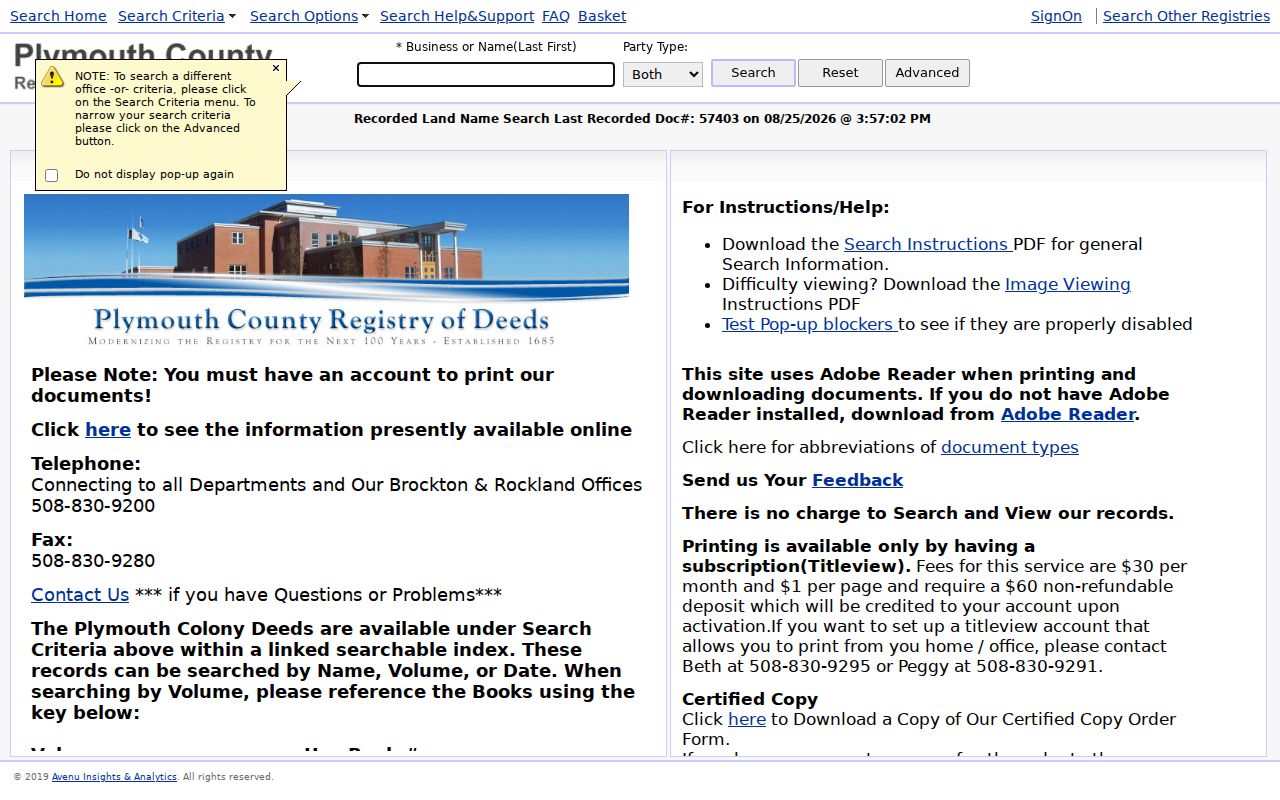
For a small result set, use the town filter for Brockton and add a date, document type, or second party. The Registry says a result set returns the first 1,000 matching rows, so an unbounded Brockton name search can hide the wanted deed. Open the image when available. An index helps locate the document, but the instrument carries the parcel's legal description in a Brockton deed, references to prior deeds, signatures, and party roles needed to continue a careful chain.
Note: Print charges and certified-copy instructions change, so use the Registry's current form before ordering.
Brockton Deed Chain Backward
Walk backward from the latest Brockton transfer. A deed establishes the legal movement of an interest in land, not necessarily the date a family arrived. In a normal Brockton backward chain, the seller on the later deed becomes the earlier buyer to search. Capture the book and page or document number every time. When a record names a trust, estate, or corporation, search the entity, trustee, and reference number rather than relying on one personal-name spelling.
- Use the Brockton assessor result to record the current owner, situs address, parcel ID, and legal description.
- Find the latest relevant Brockton deed in TitleView by property or current grantee, then note its recording date and prior-deed reference.
- Write down the seller, also called the grantor, and search that party as a grantee to locate the earlier acquisition.
- Repeat the transfer-to-acquisition pattern, comparing the legal description and plan references at every step.
- Move to Brockton Registry books, plans, and public-access stations when an early index or address search fails.
- Grantor and grantee
- The grantor transfers an interest. The grantee receives it. Their roles can swap as the same property is traced backward.
- Chain of title
- A dated sequence of recorded transfers connecting one owner interval to the next.
- Legal description
- The recorded lot, plan, boundary, or metes-and-bounds description. It can survive a street-number or name change.
Brockton's Older Registry Indexes
The Plymouth Registry is unusually deep for Brockton research. It reports linked grantor and grantee indexes from August 6, 1686 to the present, scanned books and indexes back to 1685, and more than 17 million public images. Linked search is not equally polished for every era. The Registry's older guidance describes grantor indexes before 1970 and grantee indexes before 1955 as unedited. Linked grantor search reaches from 1945 and linked grantee search from 1955, while printed volumes and original books remain the correction route for older Brockton names.
That warning is useful rather than discouraging. If a known early Brockton surname does not return, try initials, married names, trust names, the book and page, or the property and plan routes. Then use the public-access stations. The Registry says online material is also available at public stations, and Plymouth holds printed grantor and grantee volumes from 1685 forward, along with books, plans, highway and taking records, railroad books, and special collections for Brockton research.
Brockton Address Maps and Prior Households
Maps help when a Brockton deed trail reaches a lot description or an unfamiliar street number. The Library of Congress makes a Brockton Sanborn volume available for 1909 through February 1950. It has 121 sheets and six skeleton maps. The State Library list adds Brockton editions from October 1885, October 1889, 1893, 1954, and 1964. Compare the Brockton building footprint, number of stories, construction material, use, and nearby structures before deciding whether two records refer to the same site.
Permits provide a separate Brockton date trail. The Brockton Building Department maintains records for construction, structural changes, windows, roofing, siding, demolition, plumbing, electrical work, and related inspections, although uploads are limited and periodic. For older Brockton material, request records by exact street address, parcel ID, and date range from the Building Records Access Officer. A permit can show a work category, application or issue date, inspection date, and owner or applicant field. It is dating evidence, not a census of the building.
Brockton Directory Household Trail
Ownership is only half the story. The Brockton Public Library's city-directory, poll-tax, and street-directory holdings can show an occupant or business in street-number order, and the federal census adds the wider household. The collections themselves are described on the Brockton city directory page. Begin with the year closest to a deed transfer, then use the same street number in the reverse section. Directory entries are snapshots, so compare the name, address, occupation, and household notation before treating a listing as the same person.
Use this household process: deed date to nearest directory, directory to nearest public census, then newspaper or cemetery evidence for the transition. Federal census data is public through 1950 under the 72-year rule. Massachusetts state censuses from 1855 and 1865 can help between federal decades. A deed may predate a move-in or postdate a move-out, which is why a sequence of sources is stronger than one record.
Household flow: deed date → nearest directory → nearest public census → newspaper, cemetery, or probate evidence.
The Brockton Public Library Historical Room is shown in the collection image below.
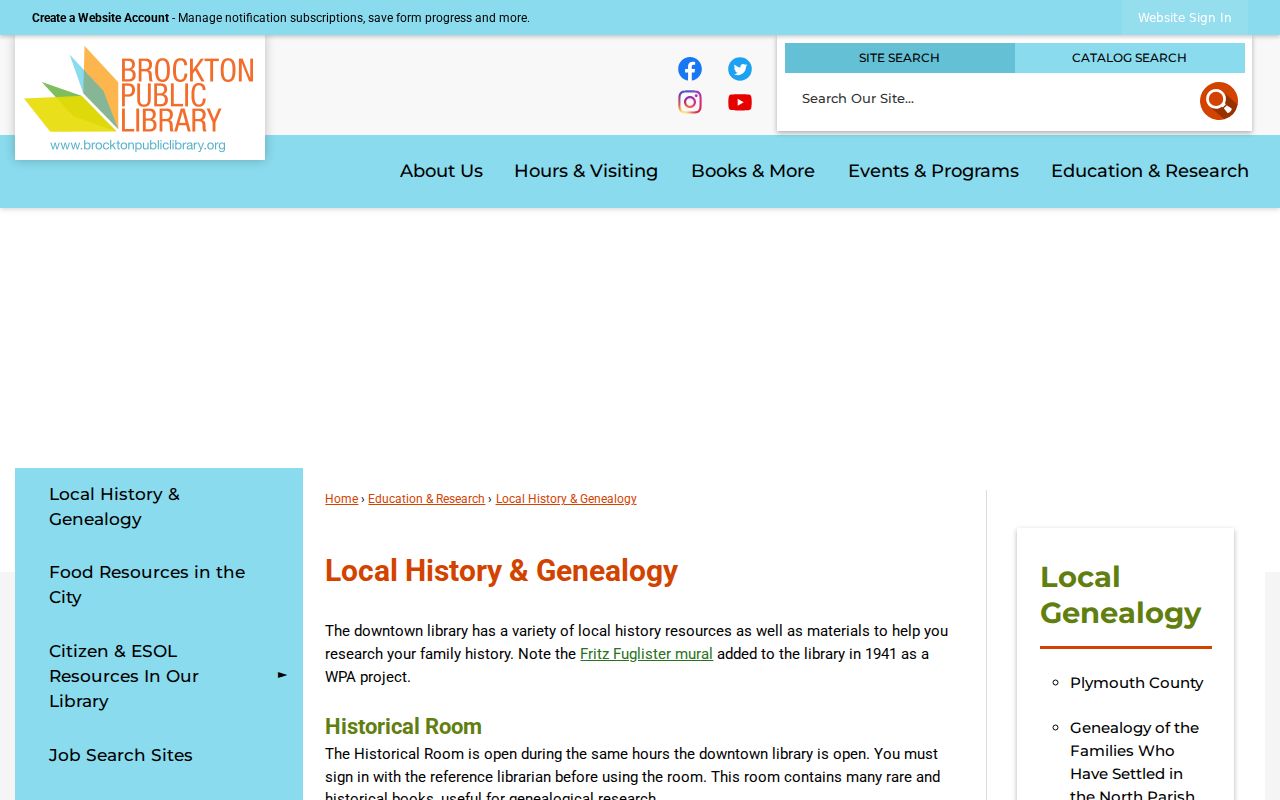
The library keeps newspaper microfilm from the North Bridgewater Gazette through The Enterprise and offers remote copies with a detailed letter, a self-addressed stamped envelope, and payment. City-directory, poll-tax, and street-directory copies are listed at $2 per page, while obituary and news copies are $3 per page. Reference-librarian help is especially useful when a street has an older name or an exact directory year is unknown.
Lawful use. Brockton previous-resident research fits family history, local history, estate questions, and personal curiosity. Do not use an address trail to stalk, harass, or harm a living person.
Brockton Trail Endpoints
Newspapers, cemetery records, and probate files can explain why a household disappears from an address sequence. Brockton Public Library has the North Bridgewater Gazette from 1851 to 1874, the Brockton Gazette in 1874-1876 and 1880-1894, the Brockton Times from 1895 to 1934, and The Enterprise from January 1880 onward. A death notice, estate notice, sale notice, or society item can tie a name to a date and place, but it should be compared with the directory and deed trail.
Brockton's cemetery search accepts a full or partial surname. Its older paper records are still being digitized, so call the Cemetery Department if an expected person is missing. Historical Plymouth probate estate files from 1686 to 1915 are available through FamilySearch image collections and can contain petitions, inventories, accounts, decrees, heirs, witnesses, residences, and property details. Current estate files route through Plymouth Probate and Family Court, where confidential parts may be restricted.
Brockton Address Names Over Time
Do not force a modern address onto an old record. North Bridgewater became Brockton in 1874, and Campello had the earlier Plain Village identity. Search all of those place labels in deeds, directories, newspapers, and maps. A legal description or recorded plan often bridges a changed number better than a postal address. The City Clerk keeps street orders for streets that were laid out, altered, widened, or discontinued, and coordinates recorded plans, takings, and easements with the Registry.
When a number does not match, compare the deed's lot or plan reference with the Sanborn map and street order. Postal ZIP labels also do not establish a city limit or who lived at a property. A dated, source-by-source timeline avoids the two common errors: treating an address label as permanent and treating a tax mailing address as proof of occupancy.
Note: Record predecessor place names beside each date so another researcher can repeat the search without assuming modern Brockton labels existed.