
Brockton Neighbors: Block Records
Public sources around a Brockton address describe different relationships to the block. The Brockton parcel record identifies an assessed owner and the mapped parcel. A Plymouth Registry deed for a Brockton parcel identifies recorded parties and the legal land description. A Brockton local voter list can be requested by street, ward, precinct, or period, subject to confidentiality rules. Brockton permit, directory, and map sources add dates and context. None of these is a complete household list. Treat an owner, an applicant, a voter, and a historical directory occupant as separate kinds of evidence.
| Block source | Evidence around the address | How Brockton access works |
|---|---|---|
| Brockton Web GIS | Parcels, adjacent owners, parcel IDs, roads, and map layers | Free map and parcel-detail access |
| Plymouth TitleView | Brockton deeds, plans, easements, recorded parties, and title history | Free search and viewing; office stations remain available |
| Brockton Elections | Public Brockton voter information by residence, where disclosable | Request a Brockton local list with street, ward, precinct, date, and format |
| Brockton Building records | Brockton permits, inspections, code records, and named applicants or owners | CitizenServe, available uploads, or a Brockton city records request |
| Brockton Historical Room sources | Past street occupants, businesses, newspapers, and poll-tax clues | Brockton library research, reader/printer, or mail-copy service |
Start with the Brockton source closest to the question. Brockton Web GIS is useful for the parcels immediately beside an anchor address. TitleView is the stronger confirmation when the question concerns a Brockton title, shared edge, or recorded easement. The Brockton assessor's situs field names the physical parcel, while a tax mailing address only tells the city where correspondence is sent. It does not prove that its recipient lives at the property. The same caution applies to a Brockton historical directory entry or a permit applicant.
Note: A missing name can reflect a protected record, an index gap, or a different record type, not proof that no connection exists.
Map a Brockton Block Carefully
The immediate-block method begins with a known Brockton address or parcel ID, not a broad name search. In the Web GIS, an address search can use the street name without “ST” or “AVE” when the number is unknown. The visible results include an ID, index, complex, unit, owner, and address, with a View Details path. Open the anchor parcel first. Then use map browse and select adjoining parcels one at a time. This keeps the work tied to actual parcel edges instead of guessing from a list of similarly named streets.
- Search the address or parcel ID in Brockton Web GIS and record the anchor parcel's owner, situs address, and parcel ID.
- Move outward through the mapped Brockton parcels. Keep a simple street-side list of each adjacent parcel ID and assessed owner.
- Open the current Brockton deed in TitleView when ownership, a shared drive, or a lot edge needs confirmation. Read the image and legal description, not only the index line.
- Use a Brockton Registry plan or legal description when a house number does not return a useful match. Plans can preserve the lot connection after a number or parcel changes.
For a longer run of addresses, use the Brockton street directory, which follows the street-wide record trail. The tighter neighbors method is better for the houses touching or directly surrounding one parcel. MassGIS MuniMapper also describes an abutter-identification capability and data-download capability, although the layers and controls available in a municipal map can vary.
A MassGIS MuniMapper overview shows the statewide mapping context for Brockton neighbor research.
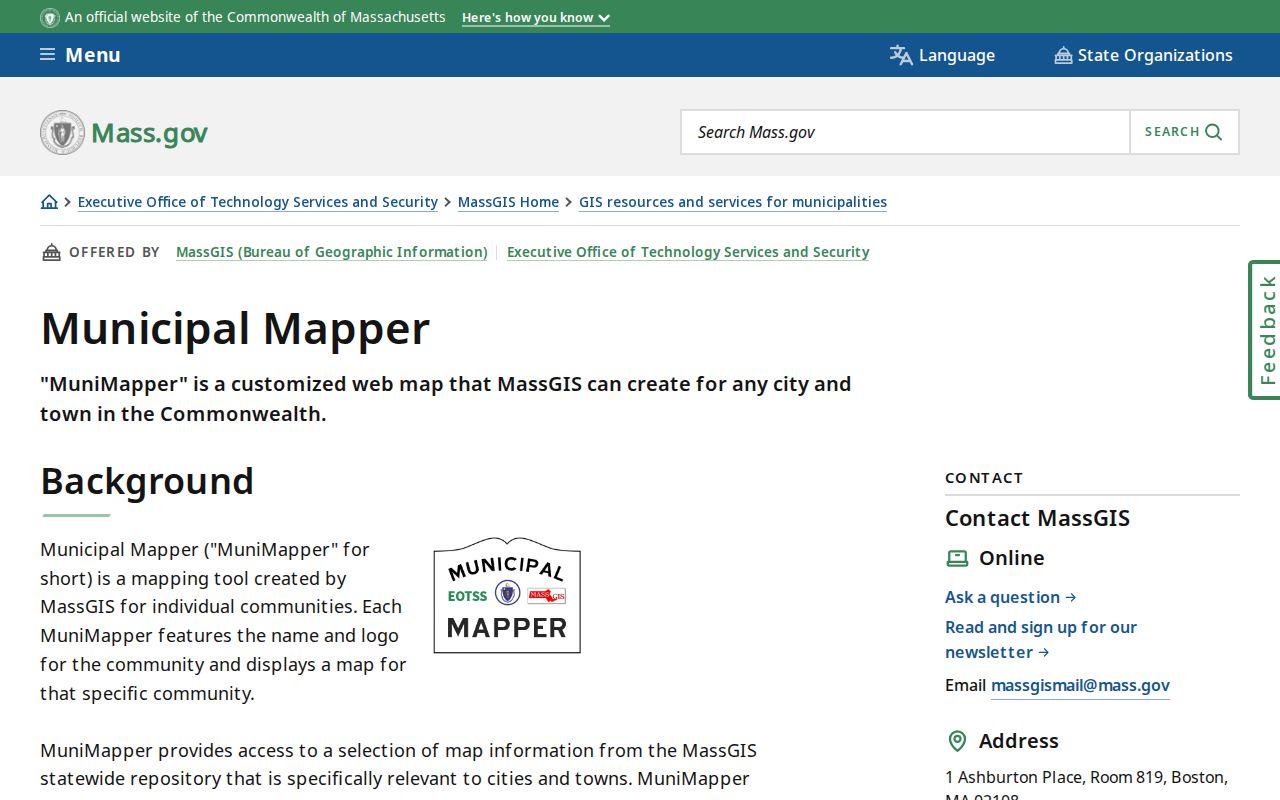
The screenshot reinforces the right use of a map layer: it supports a parcel and abutter review, then the parcel detail and Registry record supply the record-level check.
Brockton Neighbors, Plans, and Edges
Brockton parcel lines answer a geography question. They do not settle a Brockton title question. When a block has a shared driveway, a narrow side lot, an easement, or an older subdivision, move from the Brockton GIS view to the Plymouth County Registry. TitleView can be searched by Brockton property, recorded party, town, date, document type, Book/Page, document number, or plan number. The Registry's linked plan index reaches from 1890 to the present, and public stations give another route when an online search is incomplete.
Read “grantor” as the party transferring an interest and “grantee” as the party receiving one. A Brockton plan can link the mapped lot to the legal description in a deed, while the deed can identify a prior reference. That is useful for explaining a boundary or shared access route. It is not a reason to assume who occupies any given Brockton home. Plymouth Registry material reaches back unusually far, with scanned grantor and grantee books available to 1685 and linked indexes from August 6, 1686 to current records.
Brockton Neighbors in Voter Records
A state voter-status check is not a Brockton block browser. Massachusetts requires the public status tool to use a submitted name, date of birth, and residential ZIP, then return limited status, polling-place, and elected-official information. It does not display extra biographical information. For Brockton block research, the appropriate documented route is a local request to the Brockton Elections Commission for the particular municipal list or record needed. Identify the street, ward or precinct, year, delivery format, and the date of the requested record.
The local voter-record inventory can include a name, residence address, party or enrollment, date of birth, active or inactive status, voter ID, registration history, and voting participation. Ballot choices, phone and email details, confidential voters, and records related to minors or pre-registrants are not part of an ordinary public request. The statewide voter list itself is not a general public record. That split between a narrow statewide status tool and local custodianship is central to a Brockton block search.
Note: Ask for a dated local record when historical context matters, because voter status and address-maintenance records can change over time.
Brockton Neighborhood Contact Layers
Community groups can add civic context to a Brockton block, but they are not resident rolls. The Frederick Douglass Neighborhood Association describes residents and volunteers involved in engagement, arts, and garden work. Brockton Police lists Neighborhood and Business Watch groups, including the Campello Business Association. Downtown Brockton Association presents an organizational directory and a membership/contact route for businesses, nonprofits, government agencies, friends, and supporters. Use public contact routes to understand an event or community project, not to identify every person who lives nearby.
Frederick Douglass Neighborhood Association
Community engagement, arts, and garden activity. Its public site has a contact or membership route, not a public member directory.
Neighborhood and Business Watch
Brockton Police lists local watch and business-association contacts, including a Campello business contact layer.
Downtown Brockton Association
Events, organization listings, and a contact route for the downtown civic and business network, not a household list.
The older Team Brockton resident-leadership material also names Ash Street Park, Edgar Park, Keith Park, Village, and People Affecting Community Change. The research did not locate a city-maintained current umbrella roster, so their current status should be verified before relying on a contact listing.
The official Brockton Police Neighborhood and Business Watch page provides the source for the community-contact layer.
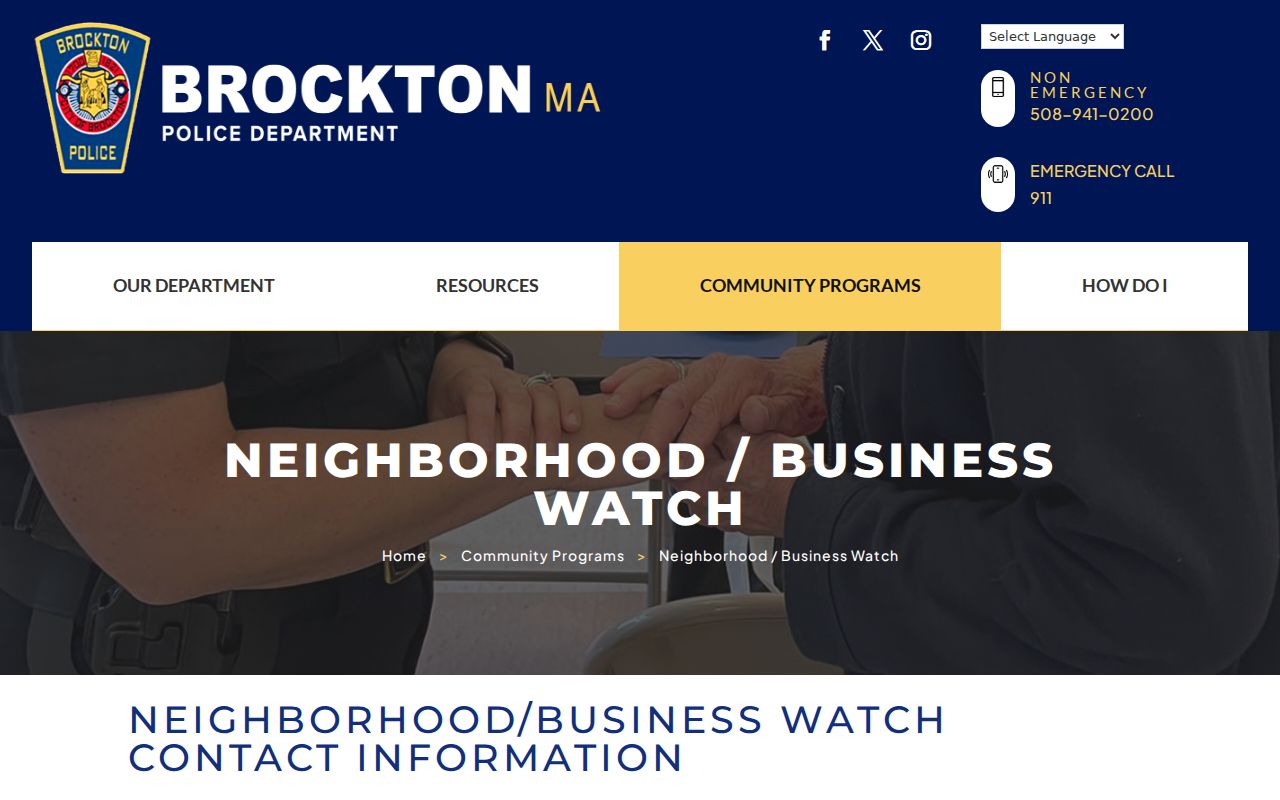
The page is useful for locating a public community contact, while the parcel and deed sources remain the proper evidence for a property question.
Brockton Neighbors: Record Comparisons
Official Brockton records and commercial neighbor-lookup products answer different questions and have different limits. A faster combined result may merge old entries, duplicate people, or present a mailing address as if it were a current residence. Brockton property and election sources are slower to combine, but they let a reader see the custodian, record type, access limit, and date. Compare Brockton records before treating an address connection as reliable.
| Official Brockton source | Commercial neighbor-lookup category | Practical difference |
|---|---|---|
| Web GIS and Assessor | Combined property profiles | GIS identifies an assessed owner and parcel; a combined profile may be stale or merge people. |
| Registry deed and plan | Address-history summary | The recorded instrument and legal description can be inspected; summaries may omit limits or dates. |
| Local voter request | People associated with an address | Local records have defined exclusions; commercial listings can overstate who is in a household. |
Use the assessor for an ownership lead, the Registry for a recorded land question, and a dated local request for public voter information. A commercial listing can be a prompt to verify a record, never the final proof.
Brockton Neighbor Context: Campello and Montello
Brockton blocks carry older place names that can change the search. North Bridgewater took the Brockton name on May 5, 1874, and Campello was earlier known as Plain Village. A nineteenth-century deed, directory, or newspaper item may use one of those earlier terms even when the property sits in modern Brockton. Campello, Montello, Downtown, Lovett Brook or Good Samaritan, Belmont, Pleasant Street, and east-side Centre, Court, and Quincy are useful planning frames, not official resident boundaries.
That history matters when a parcel trail goes cold. Search the earlier locality name in a directory or newspaper, then return to the legal description or plan reference. The local newspaper record begins with the North Bridgewater Gazette in 1851, followed by the Brockton Gazette, Brockton Times, and The Enterprise. Brockton Public Library's Historical Room holds the local street-directory, city-directory, poll-tax, and microfilm route for this kind of block context.
Permits That Date a Brockton Block
Building records can place a change on a Brockton address without identifying a full household. The Building Department maintains permits and records for construction, structural changes, roofing, siding, demolition, plumbing, electrical work, inspections, site plans, and certain licenses. CitizenServe is the online application route, but research found that public uploads are limited and periodic. When an online record is absent, request the property record by exact address, parcel ID, and date range from the Building Records Access Officer.
For a longer Brockton timeline, pair permit evidence with the Brockton assessor's permit-related updates, a deed date, and a Sanborn map. The Library of Congress makes a Brockton Sanborn volume dated 1909 through February 1950 available with 121 sheets and six skeleton maps. State Library material adds 1885, 1889, 1893, 1954, and 1964 editions. These map a Brockton building footprint, material, use, and nearby structures. They do not identify current occupants.
Note: A construction or title date helps date a property event, but it does not establish when a particular person moved in.
Brockton Neighbor Lookup Privacy Limits
Public Brockton block records have firm boundaries. A Brockton assessor record does not identify every renter or household member. Utility customers, mail recipients, and RMV address data are not a public block directory. Confidential voters, minors, Address Confidentiality Program participants, juvenile records, impounded court addresses, and protected vital-record information may be absent or redacted. Massachusetts Address Confidentiality Program protections arise under M.G.L. c. 9A and 950 CMR 130.00, using a substitute address and mail forwarding for eligible participants.
Correct an error at its custodian. The assessor handles parcel data, Brockton Elections handles voter corrections, the Registry handles deed-index errors, and the City Clerk or RVRS handles vital-record changes. For municipal records, Massachusetts Public Records Law, M.G.L. c. 66, §10 and 950 CMR 32.00, supplies the request framework. Brockton generally provides a written response within ten business days, subject to exemptions and permissible fees.
Lawful use. Use Brockton block records for civic curiosity, family history, reconnecting, or checking a property concern. Do not use them to watch, threaten, harass, or intimidate anyone; Massachusetts law treats stalking and criminal harassment seriously.