
Brockton City Directory Collections
There is no single continuous online shelf for these Brockton volumes. The practical Brockton collection is spread among the Brockton Public Library Historical Room, the State Library of Massachusetts, Historic New England, UMass Boston, and library-linked databases. The Brockton library confirms that it holds city-directory, poll-tax, and street-directory copies, but its public page does not list every year on the shelf. The State Library list for Brockton is more exact for selected city-directory runs, and it is the best starting point for choosing a year before asking a Brockton librarian to pull a local volume.
| Collection | Years | Where held | Access |
|---|---|---|---|
| Brockton local printed directory copies | Exact full shelf run not published | Brockton Public Library Historical Room | Sign in with a reference librarian; mail copies available |
| State Library Brockton directory run | Selected years, 1874-1969 | State Library of Massachusetts | Collection list and library research |
| Greenough Brockton directory | 1885 | Historic New England | Cataloged as Stacks F74.B8 B76 1885 |
| Historical Descriptive and Picturesque | 1898 | UMass Boston Digital Collections | Digitized item online |
Selected Brockton years do not mean annual coverage. The State Library list has gaps, and neither it nor the library page supports an assumption about a missing year. Treat each Brockton volume as a dated snapshot. For a volume with no online scan, the fallback is the Historical Room, a detailed mail request, or a library-to-library microfilm loan where available.
Brockton Directory Name Changes
The first search decision may be the place name, not the surname. North Bridgewater became Brockton on May 5, 1874, and Brockton became a city in 1881. Earlier material may therefore sit under North Bridgewater even when the parcel is in modern Brockton. Campello also has a deeper label: it began as Plain Village within North Bridgewater. Search those names alongside Brockton, especially when a nineteenth-century household vanishes at the point where the town name changes.
This local shift explains why the State Library run beginning in 1874 is important. It sits at the transition, rather than after it. The 1885 Greenough volume also reaches beyond the city, listing Brockton with Bridgewater, East Bridgewater, and West Bridgewater. A result in a nearby-town portion is a lead to verify, not a reason to merge two families with the same surname.
| 1851 | North Bridgewater Gazette begins its local run, giving the library's newspaper trail a pre-Brockton starting point. |
|---|---|
| May 5, 1874 | North Bridgewater takes the name Brockton, changing the place label needed for directory and newspaper searches. |
| 1885 | The Greenough Brockton directory records local people, institutions, manufacturing, societies, firms, a map, and state-census context. |
| 1898 | Brockton Historical Descriptive and Picturesque appears in the UMass Boston digital collection. |
Note: Preserve accents, middle initials, compound surnames, and spelling variants when comparing Brockton, North Bridgewater, Plain Village, and Campello entries.
Brockton Directory Research Room
The Brockton Public Library Historical Room is the local counter for rare and historical books, directories, poll-tax material, street directories, and genealogy databases. It is open during Main Library hours and requires sign-in with a reference librarian. The Main Branch is at 304 Main Street. Its listed hours are noon to 9 PM Monday and Tuesday, 9 AM to 9 PM Wednesday, and 9 AM to 5 PM Thursday through Saturday. The library is closed Sunday.
The Historical Room page is shown in the library's local-history resource below.
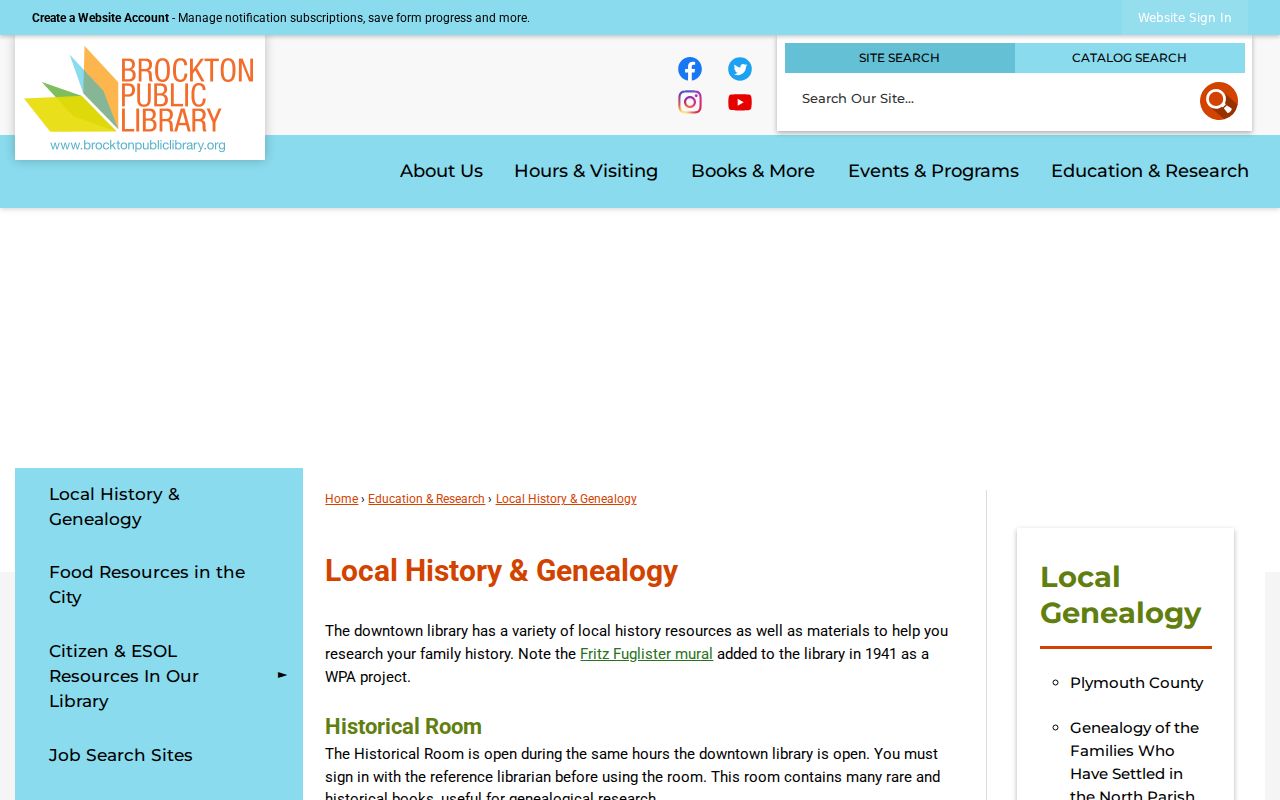
Brockton researchers use this counter when an online catalog gives only a partial answer. Two reader-printers support the Brockton newspaper microfilm, and the library can send reels through interlibrary loan. For a remote Brockton request, send a detailed letter, a self-addressed stamped envelope, and payment to the Main Branch. The stated charge is $2 per page for city-directory, poll-tax, or street-directory copies and $3 per obituary or news item.
Brockton Directory Digital Copies
Brockton digital access is useful, but it is scattered. UMass Boston's digitized 1898 Brockton Historical Descriptive and Picturesque is a direct online item. It is a Brockton descriptive historical directory rather than a replacement for every annual name volume. The Historic New England catalog identifies the 1885 Edwin A. Greenough & Co. directory as 643 pages with inhabitants, institutions, manufacturing, societies, firms, a map, and state-census material.
The State Library's directory-holdings list identifies selected Brockton years from 1874 through 1969. Ancestry access through the library and public catalog pointers can fill some selected years, but image access can depend on an account or library connection. FamilySearch, HeritageQuest, and HeritageHub are also linked by the Brockton library. Check the Brockton volume title and publication year before copying an address into a timeline.
Reading a Brockton City Directory
A Brockton directory entry is evidence of an addressable presence, not a full household census. Brockton page images were not available in the source material to confirm one fixed local abbreviation key, so read the front matter in the actual volume before expanding any symbol. Brockton person entries commonly place the surname first. Transcribe the spelling as printed, then capture the Brockton street address, occupation or employer, spouse or household notation, widow or deceased notation, and any boarder, lodger, owner, or renter mark that the volume defines.
| Name | Usually surname first; retain initials and spelling exactly as printed. |
|---|---|
| Address | Street and number for matching against the street section, maps, or later records. |
| Work notation | Occupation or employer, a useful Brockton identity marker in an industrial city. |
| Household note | Spouse, widow, deceased, boarder, or lodger wording when the volume supplies it. |
| Ownership mark | Use only the symbol definition printed in that particular volume. |
- Criss-cross directory
- The street-order section that reverses the name section, often letting an address lead to an occupant or business.
- Householder index
- An index centered on the named household contact, not a list of every person who lived there.
- Abbreviation key
- The volume's own guide to shortened words and symbols. Photograph or copy it before interpreting a mark.
Brockton Directory Newspaper Trail
The library's microfilm is the strongest companion when a directory entry needs a date or an explanation. The North Bridgewater Gazette runs from May 1851 through 1874, with a short break after 1856. The Brockton Gazette covers May 1874 to December 1876 and January 1880 to May 12, 1894. The Brockton Times runs from February 1895 to March 24, 1934, while The Enterprise is available from January 1880 to the present. These spans let a search cross the North Bridgewater-to-Brockton change instead of treating it as a blank space.
Industrial growth gives many entries added meaning. Brockton's shoe industry and the Old Colony Railroad drew people and businesses during the nineteenth century. A listed factory, shoe firm, society, or employer can guide a newspaper search, but it does not by itself prove a family relationship. The Greenough directory is especially rich because its title promises both person listings and local institutions, manufacturing, firms, maps, and state-census context.
Note: A listed firm can guide a newspaper search, but it does not establish a family relationship.
Tracing Brockton Directory Households
Use the Brockton books as a sequence, not as isolated hits. A move, a changed occupation, or a new spouse notation can distinguish people who share a name. The street section is valuable when the surname is unknown or the scan has poor text recognition. A Brockton historical hit can be checked against later address-keyed sources, but modern parcel work belongs on the Brockton street directory page.
- Start with the latest directory that covers the surname or street, and copy the spelling, address, occupation, and household notation.
- Move backward and forward through the selected runs, recording every change rather than guessing why it occurred.
- Check the street or reverse section for the same number, nearby businesses, and alternate spellings.
- Pair the nearest directory year with a public federal census year and compare household members.
- Use a deed, cemetery entry, obituary, probate record, or newspaper notice to test a move, death, or estate transition.
A disappearing Brockton entry can mean a move, death, missed canvass, changed spelling, or a different form of listing. It is a prompt for another source, not a conclusion. The Brockton cemetery search is last-name based, and older cemetery books are still being digitized, so an absent online cemetery result should be followed by a call to the office.
Brockton Directory Census Pairing
Federal census records are public through 1950 under the 72-year release rule. Pairing a Brockton directory year with the nearest public census can supply ages, relationships, birthplaces, and a fuller household. Federal census years include 1850, 1860, 1870, 1880, 1900, 1910, 1920, 1930, 1940, and 1950. Massachusetts state censuses for 1855 and 1865 can help bridge Brockton gaps between federal decades through FamilySearch collections.
Do not expect a Brockton census result to mirror a directory. One is a census enumeration and the other is a publisher's dated compilation of addressable people and businesses. Compare the Brockton address, surname variants, occupation, and household details. The match becomes stronger when several markers agree.
Note: A Brockton directory address supports a dated location clue, but it does not independently establish title or a current residence.
Brockton Directory Trail Endpoints
Close a Brockton household trail with records that explain its last local appearance. The Brockton Cemetery Department offers a last-name search for the ten city-owned cemeteries, although older paper records remain in conversion. The Brockton office can check the non-digital layer when an online search has no result. Library staff can also copy Brockton obituary and news items from microfilm. Those notices may identify a last address, relatives, an estate, or a burial place.
For Brockton estate questions, historical Plymouth probate files from 1686 to 1915 are available as FamilySearch image collections, with petitions, inventories, accounts, decrees, and executor or guardian papers. Current probate matters belong with Plymouth Probate and Family Court. These sources help test a Brockton directory transition without turning one printed entry into a claim about every member of a family.